A Family Handover for a Box of Keepsakes
A family handover for a box of keepsakes preserves names, dates and open questions, so the next person can care for each object without guessing.
The common mistake with a family handover for a box of keepsakes is to write one note for the whole box: “Grandma’s things.” That label may travel with the objects, but it cannot tell the next person who owned a brooch, why a school badge was kept, or which date is only a family guess. A little object-by-object recording gives the recipient something more useful than a confident-sounding story: a clear account of what is known and what remains uncertain.
Think of the handover as a small conversation arranged around the rooms where objects are kept. The box need not become an archive, and every relative need not agree on every detail. The aim is to pass on the objects, their context and the limits of the family’s memory together.
What should the handover say?
For each keepsake, record three things separately: what the object is, who is connected to it, and when that connection is thought to have begun. Add the source of the information where you can. “Auntie May said Dad wore this at school” is more useful than “Dad’s school badge” if the speaker and the wording are known.
Keep observation apart from recollection. “Blue enamel badge with a pin fastening” describes what is visible; “belonged to Dad” is a family claim. If the claim comes from a note, a relative’s memory or a label, say so. If nobody knows, write “not known” rather than leaving a blank that might later be mistaken for an omission.
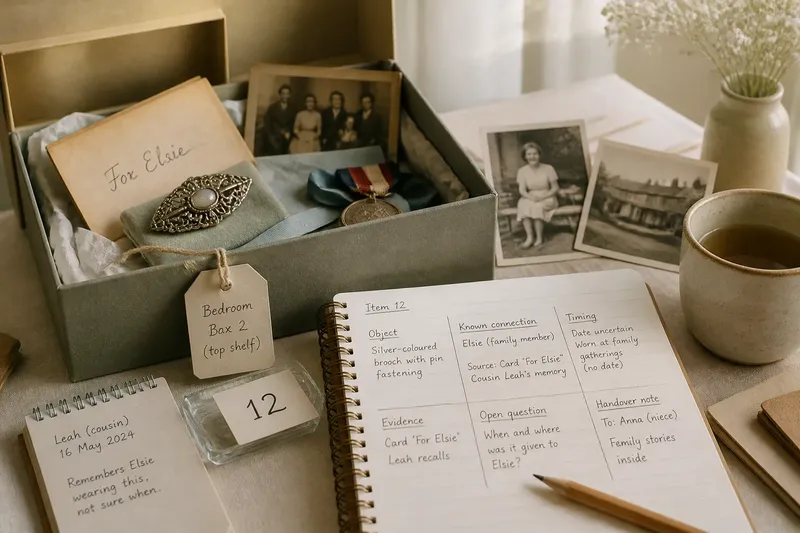
Use plain language, not an attempt at museum-style certainty. A compact record can include:
- Object: a description that distinguishes it from the other items.
- Known connection: a person, household, occasion or place, with the source of that link.
- Timing: an exact date only if it is documented; otherwise use wording such as “before the family moved” or “date uncertain”.
- Evidence: the wording on a tag, the presence of a photograph, or the name of the relative who remembers it.
- Open question: a detail the recipient may want to ask about, without presenting it as settled fact.
- Handover note: who is receiving it and any family context that should travel with it.
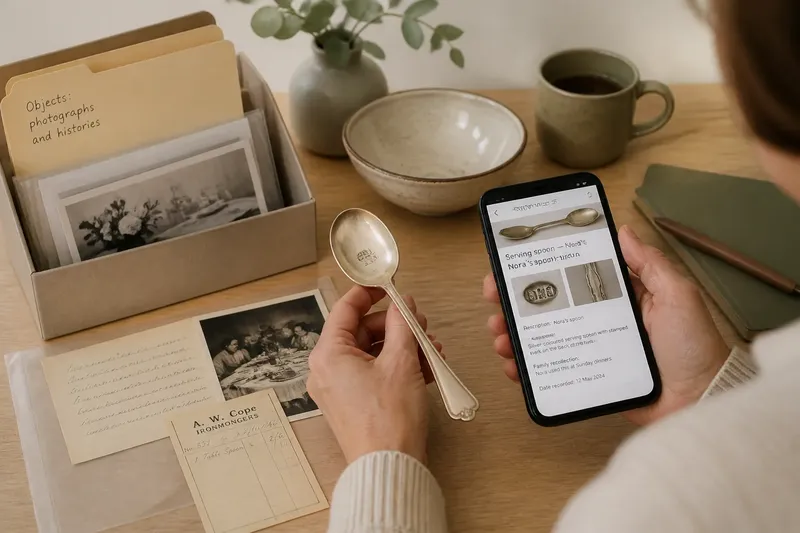
A simple pencil-and-paper sheet works well for a small group. Give each item a short identifier, then use the same identifier on its photograph and record; a removable paper slip placed beside an object during photography is less confusing than writing on the keepsake itself.
Where do you begin in the house?
Start where the box is stored, not where a perfect archive might begin. In the spare room, a sewing tin may sit beside an old photograph album; in the hall cupboard, a medal may have been kept with letters. Those neighbours can offer context, but proximity is not proof that the objects share an owner or occasion.
Before moving anything, note the box’s current contents and any existing arrangement that seems meaningful. If the items are already separated into envelopes or small containers, record the grouping before rearranging it. The container itself may carry a name or a family label, so photograph its exterior and interior before discarding or replacing it.
Imagine you find a silver-coloured brooch in a bedroom box, beside a card that reads “For Elsie”. You photograph the brooch with a separate identifier, transcribe the card exactly, and record that a cousin remembers Elsie wearing it at family gatherings but cannot place the date. The recipient can then distinguish the visible evidence, the family memory and the unanswered timing question without being handed a polished story that hides the gaps.
How can each room help without turning into a guessing game?
Bedroom: Look for jewellery boxes, clothing tags, handwritten names and photographs stored with personal belongings. Record the location and association before separating anything; a photo tucked into a box may identify a person, but it does not by itself establish who owned every item inside.
Living room: Small ornaments and framed pictures often acquire family stories through display. Note who remembers seeing an object there and, if known, during which household period. “Always on the mantel” may mean “always during my visits”, so preserve the speaker’s exact scope rather than silently widening it.
Kitchen or dining area: A recipe card, serving piece or commemorative mug may connect an object to a gathering. Write down the occasion only when someone can name it or a document supports it; otherwise record the association as a memory, not a date.
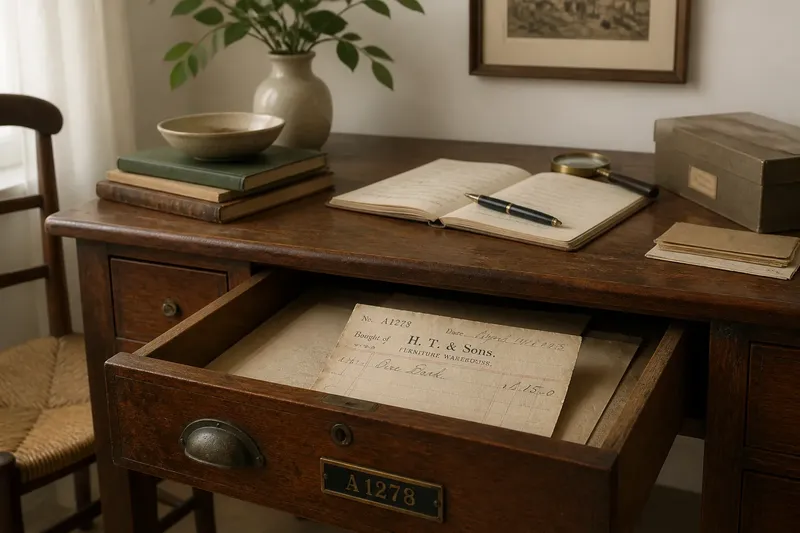
Study or desk: Envelopes, certificates and old correspondence can identify people or places. Keep the item and related paper linked by the same record identifier, while making clear whether the document names the object or merely came from the same household.
Garage, loft or storage cupboard: Take extra care with objects that have been packed for a long time. A box label can describe its contents at the time it was packed, not necessarily the origin of every item. Photograph labels in place and retain their wording in the notes.
These room notes are prompts, not a route that every household must follow. If a keepsake has already been brought to the table, record its present location and continue from there rather than delaying the handover to search the whole house.
How should photographs and family memories be recorded?
Make one clear photograph of each item, then add a close view of any inscription, maker’s mark, repair or distinctive feature that may help identify it. Use a plain background and keep the identifier in the frame without letting it cover the object. Avoid handling fragile pieces more than needed to arrange a photograph.
Write down who supplied a memory and when it was shared. A useful note might say, “Leah recalls that her father kept this in his desk; she does not know when he acquired it.” That gives the next custodian a person to ask, while leaving room for the memory to be incomplete.
Do not turn family recollections into a vote. When two relatives remember different owners, record both accounts with their names and any reason they give. The disagreement is part of the object’s history; choosing the tidiest version may erase the clue that helps someone ask a better question later.
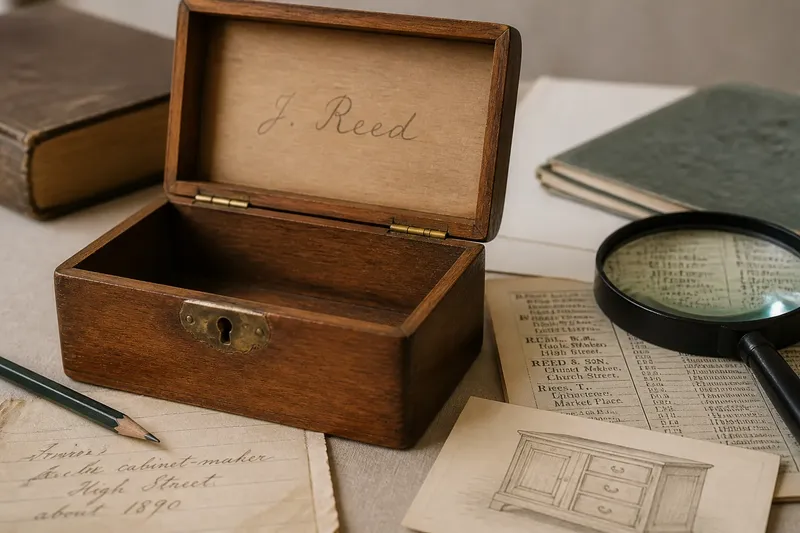
For paper records, preserve original wording in quotation marks and add your explanation separately. A label saying “Mum’s” may refer to the writer’s mother, the recipient’s mother or a nickname. Keeping the exact text beside the person who found it prevents a later reader from mistaking interpretation for transcription.
What questions do families ask before passing keepsakes on?
Should the recipient get the original notes?
Yes, if the notes belong with the objects and the recipient agrees to keep them. Provide a copy for the family member handing the box over, so later corrections or memories can be added without changing what the first record said.
What if nobody knows who owned an item?
Describe what can be seen and write “owner unknown” or “family connection uncertain”. Add any possible lead as a question, such as “Could this be from the cottage?” rather than placing it under a person’s name as fact.
Should a keepsake be cleaned before it is handed over?
Do not clean it simply to make it look ready for the handover. A surface mark, old wrapping or attached label may carry useful context, and unsuitable cleaning can cause damage; ask a conservator or other qualified professional if the object appears fragile or valuable.
How should private family details be handled?
Share only what the recipient needs to understand the object and its care. If a note includes sensitive family information, ask the people concerned before passing it on, or keep that account separate from the object record.
How do you make the next owner’s job easier?
Put the record where the recipient can find it without fastening it to the object. A labelled envelope in the box, or a small folder stored beside it, keeps notes together while avoiding adhesive, tape or ink on keepsakes. For a digital copy, use filenames that match the item identifiers and make sure the recipient can open the files without relying on your account.
Give the recipient a brief spoken account as well as the written notes. Point out which details come from documents, which come from memory and which remain unresolved. Invite them to add their own observations with a date and their name; a new recollection should supplement the earlier record, not silently replace it.
Before the box leaves the room, check that every object has a matching record or an explicit note that it is not yet identified. Keep related paper with the item where that association is known, and mark uncertain pairings as uncertain. A family handover for a box of keepsakes is strongest when it passes on not just names and dates, but the freedom to keep asking what the family does not yet know.