The Authentication Myth: Why One Mark Cannot Prove an Object’s Past
One mark cannot authenticate an object by itself. Learn what a stamp can show, where it misleads, and how to weigh it against records and context.
The common mistake when an old object turns up in a cupboard is to treat its stamp as a certificate. That shortcut can turn a copied mark, a reused component or a misread name into a confident family story. The authentication myth is simple: a mark may be genuine without proving that the whole object is genuine, old or made by the person named.
What does a mark actually establish?
A mark establishes what you can observe: a stamped symbol, an engraved name, a paper label or a scratched set of initials in a particular place. Its meaning depends on what kind of mark it is. A maker’s mark may point towards a workshop; a retailer’s label may identify where an object was sold; initials may suggest an owner, but do not identify one on their own.
Keep the claim narrow. “A crown-shaped stamp appears beneath the base” describes visible evidence. “This is an authentic object made by a particular workshop” is a much larger claim, requiring support beyond the stamp.
Why can a real mark appear on the wrong object?
Marks can be copied, imitated or misunderstood. A genuine component may also be reused in a later assembly, while an authentic workshop stamp may have appeared on more than one type of object. Even a correctly read name might refer to a retailer, importer, owner or repairer rather than the maker.
Wear adds another wrinkle. A faint letter can resemble a different character, and an attractive match in a reference book can tempt you to overlook a mismatch. Record what is visible, including gaps and doubtful readings, instead of silently filling them in.
How can you check an authentication claim without overreaching?
Start with a clear record, then compare the mark with the object and with sources that explain their basis. A phone camera, soft light and a museum collection catalogue can help; no single tool turns resemblance into proof.
- Check whether the mark’s location is clear in a photograph; if it is, record the location in plain words, but if it is hidden, take a wider view without moving or forcing the object.
- Check which letters or symbols are plainly visible; if the reading is clear, transcribe it, but if characters are uncertain, use brackets or question marks rather than completing the name.
- Check whether a reference describes the same kind of object and mark; if both match, note the specific shared features, but if the reference is only visually similar, keep it as a lead rather than an identification.
- Check whether the mark belongs to the object or only one component; if the construction can be seen safely, note how the parts meet, but if inspection would require dismantling, stop and consult a suitable specialist.
- Check whether a family photograph, letter or receipt mentions the object; if it does, preserve the source and its exact wording, but if it does not, leave ownership or date unresolved.
- Check whether your note separates observation from interpretation; if it does, file it with the unaltered photographs, but if a guess reads like a fact, rewrite it before sharing the record.
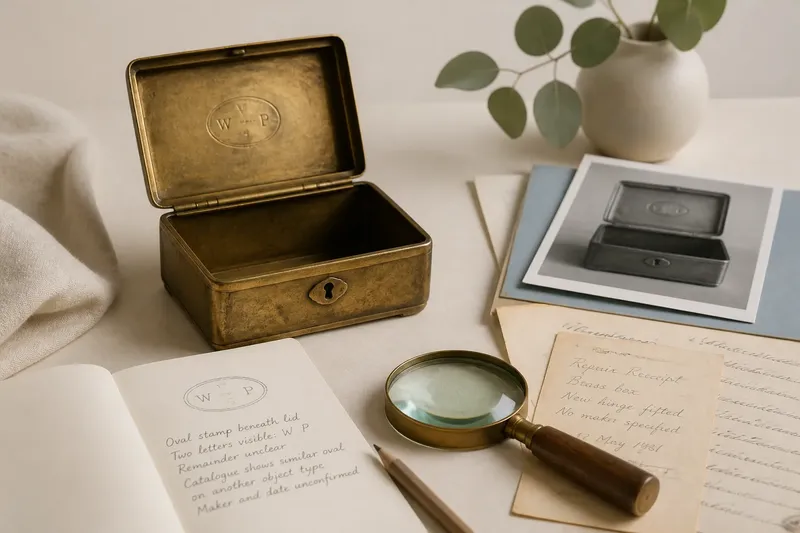
Say you inherit a small brass box with a faint oval stamp beneath its lid. You photograph the whole box and the stamp in place, then transcribe two visible letters and mark the remaining characters as unclear. A museum catalogue shows a similar oval stamp, but describes it on a different sort of object; you record the resemblance and the mismatch, then check a family repair receipt that mentions the box without naming its maker. The resulting note supports a possible connection, not an authenticated maker or date.
Which questions help you judge a mark?
Does a maker’s mark prove an object is genuine?
No. A copied stamp or reused component can carry a genuine-looking mark, so the object’s construction, condition and documented history also matter. If those clues conflict, keep the identification open.
Can a mark identify an owner?
A name, monogram or inventory mark may suggest a person or household. Compare it with records that identify the same object, and keep the owner’s identity tentative if the link is indirect.
What should I do if I cannot read a mark?
Write down the shapes you can see and leave uncertain characters unresolved. Use soft light for another photograph, but do not scrape, polish or chemically treat the surface to make the mark clearer.
When should I ask a specialist?
Seek advice from a conservator or a specialist in the object’s material if closer inspection would mean cleaning, opening or dismantling it. Professional guidance also matters if the attribution will affect a significant family, legal or financial decision.
How should you write the record?
Separate the entry into three parts: what you observed, what a source suggests and what remains unknown. For example: “Oval stamp beneath lid; two letters visible. Catalogue contains a similar stamp on another object type. Maker and date unconfirmed.” Keep the source’s title and wording with the note so another reader can assess the comparison.
When you search for how to authenticate an object by its mark, use the mark to frame a question, not to supply its answer. That distinction lets the next person revisit the evidence without inheriting a guess as family fact.